
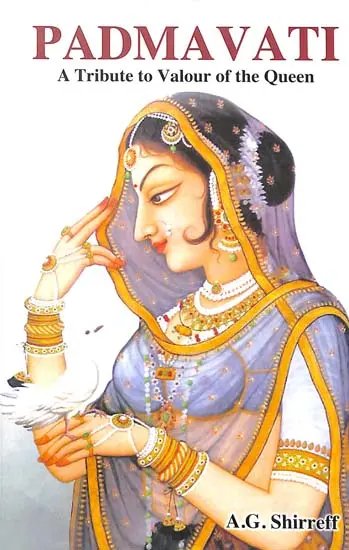
Padmavati: A Tribute to Valour of the Queen
Original price was: ₹1,495.00.₹1,270.00Current price is: ₹1,270.00.
- Publisher : Shubhi Publications
- Author : A.G. Shirreff
- Binding : Hardcover
- Edition : 2024
- Language : English
- ISBN : 8182901200
- Print length : 394 pages
- Item Weight : 600 g
- Dimensions : 23 x 15 x 3 cm
In 1911, the fasciculus VI was published carrying the Text, Commentary, and critical Notes up-to Cantos I- X.XV (vv ii 1-286), but Pandit Dvivedj was no more. Mr. Grierson wrote feelingly: “With much sorrow I have to record the lamented death of my old friend and colleague MM. Pandit Dvivedi, the Joint Editor of this poem, until arrangements can be made by the Asiatic Society of Bengal for another scholar to carry on his task, the publication of this edition of the Padmavati is necessarily suspended.
The idea of completing Sir George Grierson’s translation of the Padmavati occurred to Mr. A. G. Shirreff, I.C.S., in 1938. He obtained Sir George Grierson’s permission to carry on the work and finished the bulk of the translation in 1940, i.e., exactly in the year of the tetracentenary of the composition of the poem by Malik Muhammad Jaisi under the patronage of Sher Shah. Mr. Shirreff has carefully consulted all the important texts of the poem published so far and has also fully utilised the opinions and criticisms of scholars, European as well as Indian, who have made Padmavati their favourite study. But the remarkable feature in his English rendering of this magnificent poem is that he had some special advantages for the study of the poem, which was composed in and about the village of Jais in the Sultanpur district, Faizabad division. Knowing as he does so thoroughly the dialect of that area Mr. Shirreff could explain many obscure passages of the poem which appear to us today as a metrical encyclopaedia of Hindu-Islamic lore of medieval India.
The myths and legends, as well as the peculiar idioms and metrical devices of the Hindu and Islamic poets, have been woven into a homogeneous and harmonious composition of inestimable value. What Alberuni achieved in prose in the middle of the eleventh century while surveying Hindu philosophy and sciences was achieved with rare originality and thoroughness by Malik Muhammad Jaisi in his metrical epic on the life of the Rajput heroine, Padmavati. As a worthy disciple of Kavir, he shines, to us to-day as a real pioneer in the path of Hindu-Islamic cultural rapprochement which found its culmination in the reign of Emperor Akbar, the four hundredth anniversary of whose birth has recently been celebrated. Nanak, Kavir Tulsidas, and Jaisi thus inaugurated a new era of cultural collaboration, which may serve as an example to later generations. Jaisi received a lasting tribute, which he fully deserved from a brother poet of Bengal, Alawal, who prepared his Bengali version of Parinsavaa while working at the Court of Arakan in 1659.
Mr. Shirreff has placed all lovers of medieval Indian literature under special obligation by offering his Padmavati to the public through our Bibliotheca Indica series. His English rendering has definitely caught the inspiration of the master poet, and in offering our thanks to him, we congratulate him at the same time on his signal success.
There is £4.99 charge for delivery under £50 Orders. Additional charges will be imposed by our couriers for delivery to remote area, a surcharge may be levied to cover carriage to these areas.
| Weight | 1 kg |
|---|

Kashi Shaivism : The White Diamond (Hardcover)
Original price was: ₹1,295.00.₹1,165.00Current price is: ₹1,165.00.
Ramayana in World Art and Thought
Original price was: ₹2,995.00.₹2,695.00Current price is: ₹2,695.00.
The Life & Legacy of Maharaja Ranbir Singh
Original price was: ₹1,995.00.₹1,795.00Current price is: ₹1,795.00.
Life & Legacy of Maharaja Hari Singh
Original price was: ₹1,495.00.₹1,350.00Current price is: ₹1,350.00.
 Padmavati: A Tribute to Valour...
Original price was: ₹1,495.00.₹1,270.00Current price is: ₹1,270.00.
Reviews
There are no reviews yet.